

Lately, most of the market conversation has been dominated by artificial intelligence. New tools, new breakthroughs, new winners. But beneath the headlines, something quieter and more structural has been developing inside the stock market itself.
The market’s recent gains have been driven by a very small group of very large companies. Today, the ten largest stocks make up roughly 40% of the S&P 500, a level even higher than what investors experienced during the dot‑com era.
That fact alone doesn’t predict anything. But it does deserve attention.
Where the concentration really shows up
Looking at the market by sector helps put this into perspective. Information Technology now represents about one‑third of the entire S&P 500. When Communication Services is added, those two sectors alone account for more than 40% of the index.
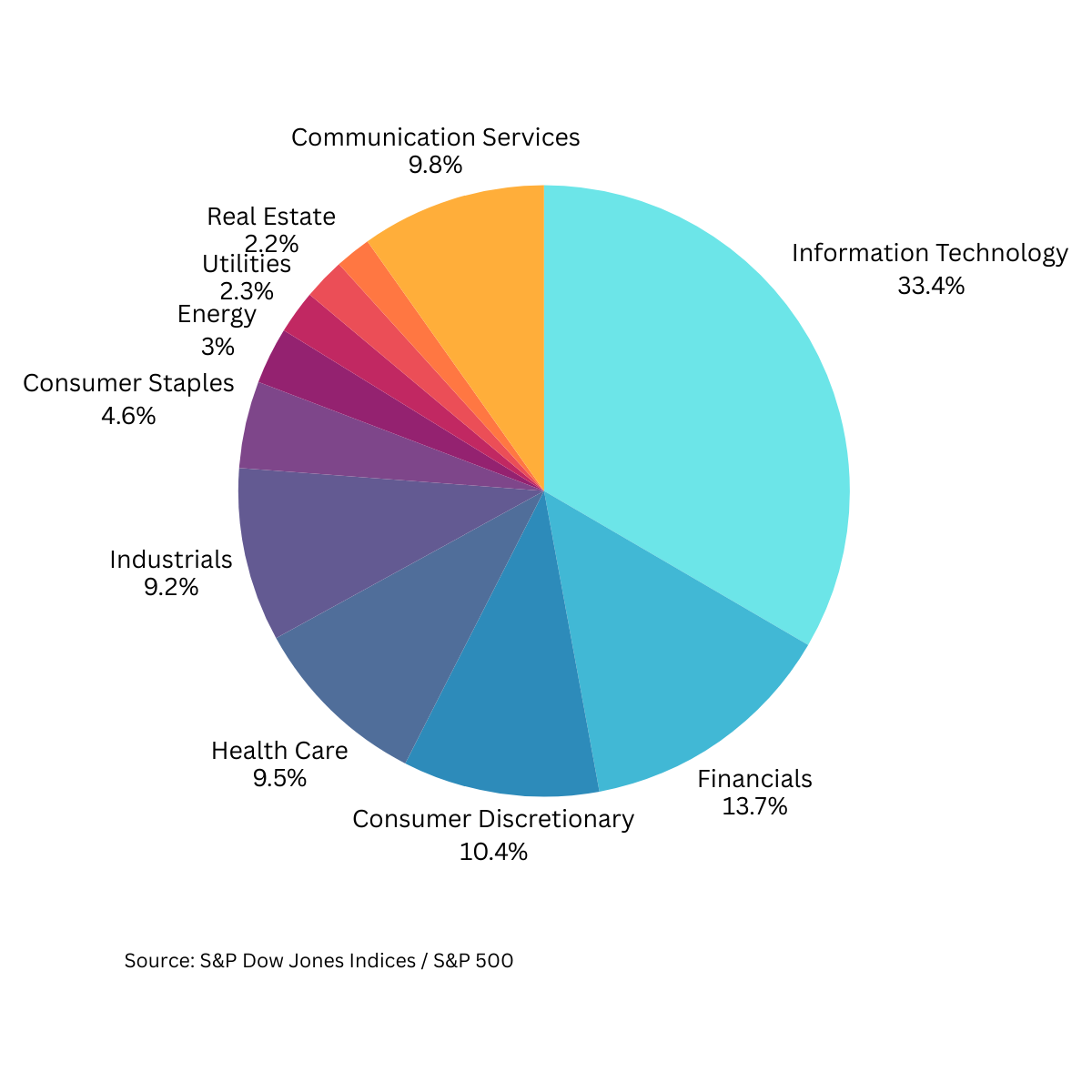
Many of today’s household‑name stocks fall into those categories. Some are classified as Technology, while others, such as Meta and Alphabet, live in Communication Services. Different labels, same concentration story.
When that much of the market’s performance depends on a narrow slice of companies and sectors, diversification can quietly erode without investors realizing it.
Why concentration feels comfortable, until it doesn’t
Periods of market concentration often feel fine while they’re happening. Strong leaders pull the market higher, and investors are rewarded for owning what is working.
The challenge is that concentration tends to hide risk. When leadership is narrow, setbacks in just a handful of stocks can have an outsized impact on overall market returns. The risk usually doesn’t announce itself ahead of time.
History shows that markets don’t need every stock to stumble for conditions to change. Sometimes leadership simply rotates. New areas begin to participate while yesterday’s winners pause or lag.
Early hints of rotation
We have already seen glimpses of this dynamic. There have been days when mega‑cap technology stocks struggle, yet the broader market holds up reasonably well. Smaller companies, value‑oriented stocks, and long‑ignored sectors have quietly started to contribute again.
This doesn’t mean the leaders are finished. It simply means the market may be trying to broaden its footing.
This is not a forecast, it’s a reminder
None of this is a prediction. Markets rarely move in straight lines, and leadership can persist longer than many expect.
The takeaway is simpler. When returns depend heavily on a narrow group of stocks, risk tends to stay hidden right up until it matters most. That is why having a plan to manage risk and adapt when conditions change is just as important as participating when markets are strong.
Markets do not ring bells at turning points. They quietly nudge investors to look beyond the in‑crowd.
As we head into the end of the year, that is worth keeping in mind.